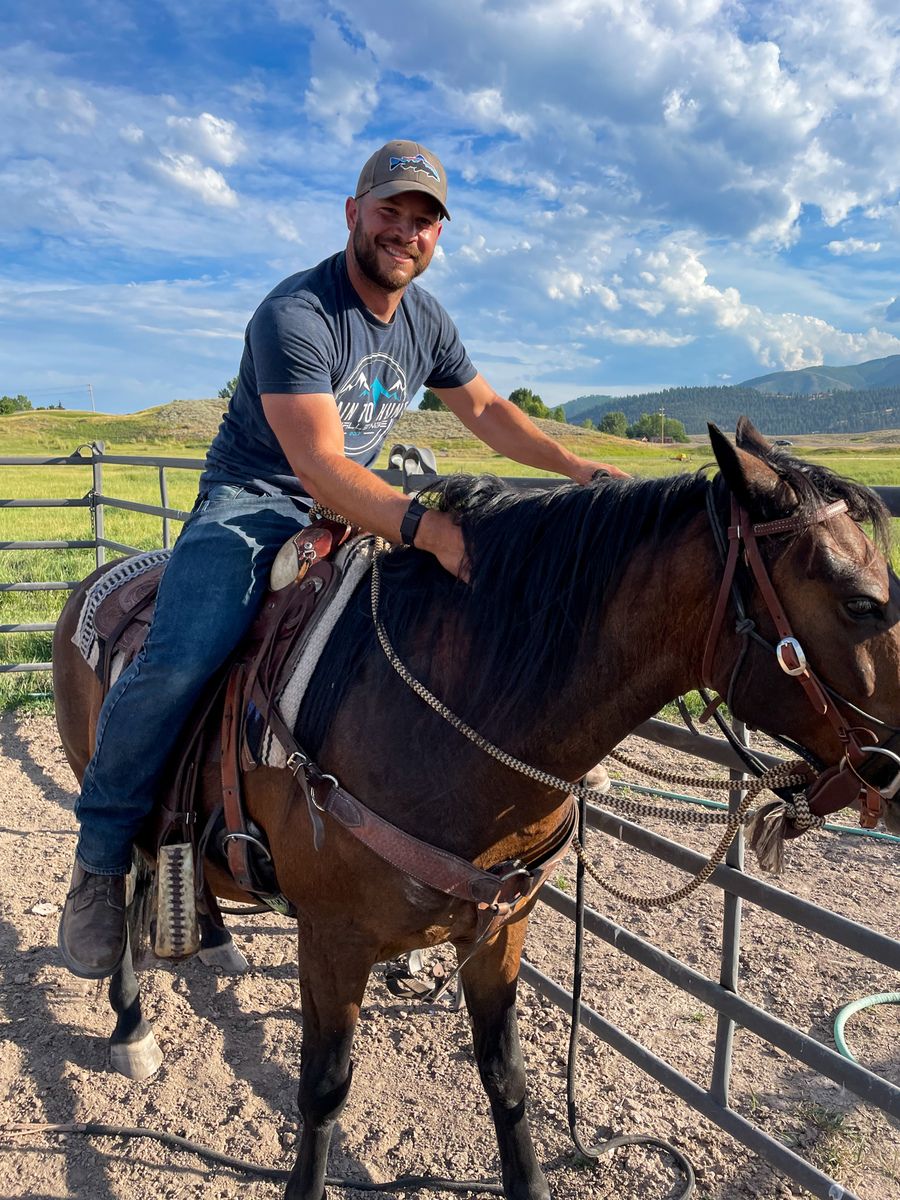

If you're thinking about taking your first horseback riding lesson, and you're a few years past your twenties, I'll say this up front: beginner horseback riding lessons are about learning to relax, communicate clearly with your horse, and move at a pace that builds confidence and skill one step at a time. You're not too old, and you're not the only one who's nervous.
A lot of us come to horses later in life. Maybe you were around them growing up. You knew people who had them, but you never spent real time in the saddle or got any formal instruction on horsemanship. Now you're curious. You want trustworthy guidance before that first lesson, and you're a little embarrassed about being the beginner in the arena.
I get it.
I remember my first time up. I was tense, even though tense is exactly what you don't want. In the back of my mind, one question kept looping... what if this horse starts to buck? The horse was only about 14.2 hands. It felt like 18.
And it was still awesome. Being up on top of such a majestic animal is something I'll never forget. That's also why the basics matter so much early on: horses feel tension, and learning how to manage your nerves, stay safe, and approach the ride with respect sets the tone for everything that follows.
So here's what I wish I'd known before that first lesson. It comes from informal lessons at my in-laws' property, clinics (as both an auditor and a rider), and a few mistakes along the way. We'll get into what to expect before you ride, how to handle nerves, how horses read your body language, what to look for in an instructor or barn, a few ground skills that help you feel more comfortable, and the mindset that makes learning a whole lot better.
Your horse can feel your tension

The biggest thing I've learned is that horses can sense tension. It's amazing how in tune they are with the rider, and with everyone around them.
First, a horse is a prey animal. To them, we can look like a predator. So when a tense person climbs up on their back, the horse may be thinking, "What's wrong? Is this person about to do something to me?" Think of a mountain lion jumping on their back.
Tension also shows up in your body. When we're nervous, we naturally squeeze with our legs. Meanwhile, your hands and reins may say one thing while your legs say another. That's a mixed signal, and the horse is left guessing which one to believe.
So what do you do about it? Breathe. Relax. Visualize what you want to have happen.
And don't think about what you don't want, because that may end up being exactly what you get.
Show up early and ask your questions
Be early. Give yourself time to settle in, look around the barn, and get your head right before anybody asks you to climb on a horse.
Then ask questions. Lots of them. Don't hold a question in because you're worried about looking foolish. Every answer you get builds a little more comfort and confidence, and that's what you're really there for.
If wearing a helmet would make you feel more comfortable, wear one. Don't think twice about it.
And pay no mind to what other people might think or say about you. You're there to learn.
Pick your barn and instructor with your gut
Every barn and every instructor is different. I've had informal lessons on my in-laws' property through a friend. I've attended clinics as an auditor, watching from the rail, and as a participant on horseback.
So I won't hand you a rulebook. I'll give you this: go with your gut, but also check a riding program's instructor credentials and safety measures.
Pick a mentor who gives you a good feeling. (And note, it may not always be the most "experienced" instructor.) Someone who doesn't rush things and is willing to answer your questions. Someone who promotes a supportive environment.
Community reviews can also help you spot reputable lesson barns. Then look at the horses. They should be in good condition and of sound mind.
If the horses feel forced, or something seems off... something probably is.
Slow down, and don't blame the horse
As humans, we want to go fast. We want to progress fast. Going into lessons, you have to be okay with going slow when you need to.
Maybe you just need more time drilling one lesson. Or maybe you and your horse are "training" at the same time, and he isn't ready to move on to the next thing yet. It's a balance. You want to push your comfort zone, but you can't get frustrated if it's best to stick with one thing a little longer.
Here's what that looked like for me.
The first time I got bucked off, I was out in the pasture on my own, working on a few things. It scared the poop out of me. I was grateful I didn't get injured. And I did not blame the horse.
I had given a signal with my foot too far up on him, and it surprised him. Like I snuck up on him. Did he buck because of that one mistake? Or because I hadn't prepared him enough going into the ride? I can't say for sure.
What I can say is this: people want to blame the horse for everything that goes wrong, and that isn't fair. We act like we're the reason things go right and the horse is the reason things go wrong. The horse shouldn't be the scapegoat for our lack of preparation.
Get comfortable on the ground first

I think comfort on the ground is critical. Before you ever put a foot in a stirrup, you want to know where the horse is at that day.
Start by reading him. Are his eyes soft, or can you see the whites? How is he breathing? What are his ears telling you?
Then try something simple. With the horse haltered and on a lead rope, can you move his feet left, right, forward, and backward? If you can, you've got a conversation going. If you can't, you'd much rather find that out standing on the ground.
One tool I find really helpful is Ty Evans' pre-flight checklist. It's what he teaches in his clinics, and he says the basics apply no matter your discipline: trail riding, roping, jumping, packing. On the ground, it starts with sending the animal left and right, then in a circle, then moving the hindquarters and bringing the front end across. It also covers backing up and lateral flexion.
In the saddle, it starts with standing still for 10 to 15 seconds. If the animal won't stand, you don't move on. Finish each step before starting the next, and the order matters for a reason.
I'll be honest about where I am with it. I've used abbreviated versions from the ground, and I'm now teaching our equines the maneuvers, so this becomes my staple pre-flight checklist.
You don't need to know any of this for your first lesson. But it shows you what "prepared" looks like, and it's a good thing to listen for when your instructor talks about getting ready before getting on.
You're still a student on your equestrian journey, and that's the point
I'll leave you with three quotes that have stuck with me.
"I'm still on the move; I'm getting better because I'm still studying. I still want to be a better horseman."
"You're not working on the horse, you're working on yourself."
"Courage is being scared to death, but saddling up anyway."
Buck's quote reminds me that being a student is nothing to be embarrassed about. Ray's is the lesson I took from getting bucked off. And John Wayne's is me on that 14.2 hand horse that felt like 18.
So book the lesson. Show up early. Ask your questions. Breathe. And go slow.
You're not too late. You're an aspiring horseman.
