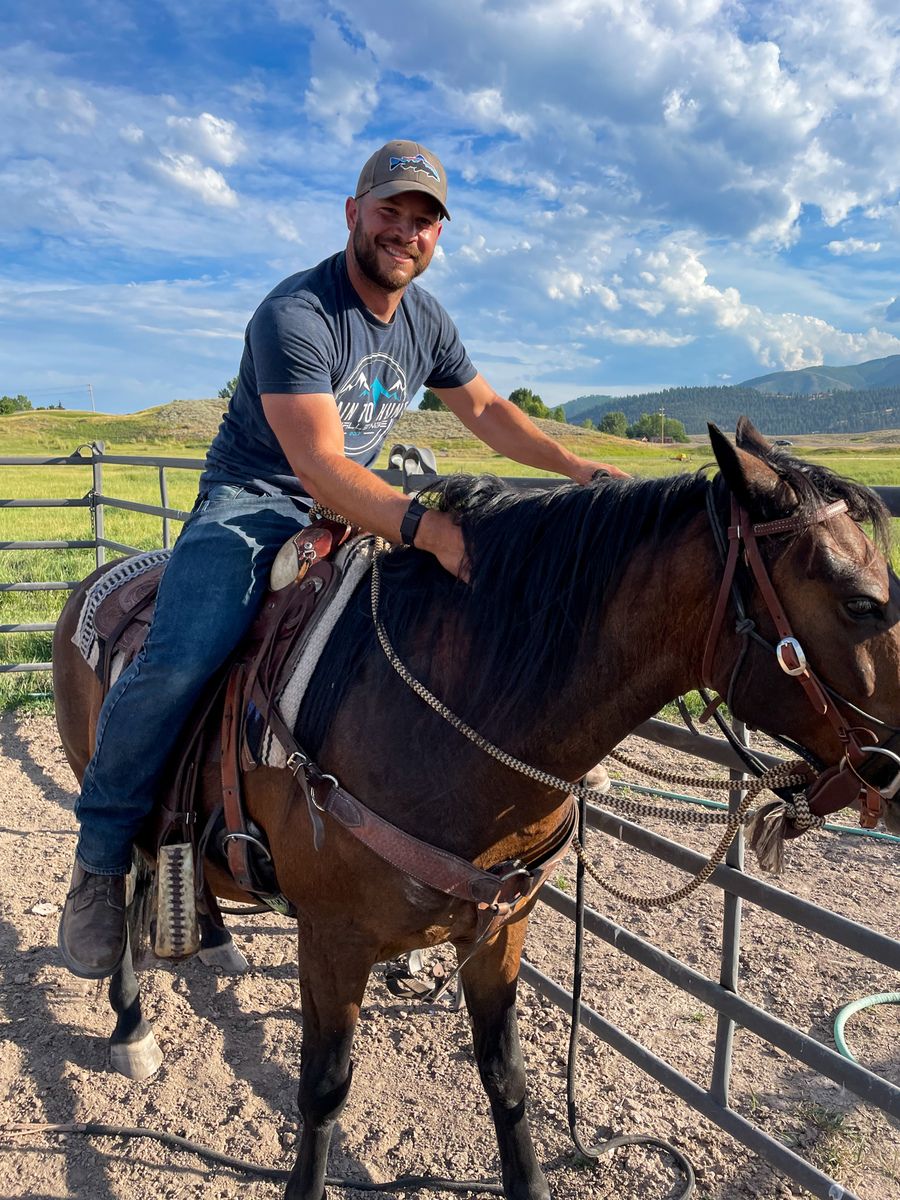

It's still dark when we feed. Hay gets thrown, we take them to the creek for water, saddles go on by headlamp. Then we ride out.
The woods are quiet except for the horses. Hooves on dirt. Shoes clicking on rock. The air is crisp enough that you can see their breath. And somewhere on that first stretch of trail, it hits me: I'm actually doing the thing I used to watch on a screen as a kid in the Midwest.
So, can you learn to ride horses as a complete beginner?
Yes. I'm not going to pretend it's easy, quick, or risk-free. But it's possible, and the path is more open than you think. Here's how it went for me, what I got wrong, and how I'd tell you to start.
If you feel like life is passing you by, you're not alone
I think I know who's asking this question.
You've always had a pull toward horses. Maybe since you were a kid. But you never had one, and you never had anyone close to you who did. No barn down the road. No uncle with a ranch. No way in.
Now you're older. Not old, but old enough to notice the years moving. And there's a quiet worry underneath it all: that you're going to run out of time to try the things you always wanted to try.
That was me.
I grew up in the Midwest watching Western movies and videos of backcountry hunts on horseback, dreaming that I'd get to do that someday. When I finally got my chance, I had some experience on the ground, mostly haltering and handling horses; but, I had no real training skills. And I had very little time in the saddle.
I wasn't a horseman. I was someone who wanted to become one.
How I actually got started
My door opened when I met my wife. Her family has horses and mules, and they use them to hunt in the backcountry. They also have enough land to do some real training. Marrying into that family put me around horses for the first time in a meaningful way.
But access isn't the same as knowledge. So I started where a lot of people start now: YouTube.
I went deep. I watched a lot of different trainers, and I was picky about it. If a trainer's approach or demeanor didn't sit right with me, I moved on. When someone resonated, I went through everything they had.
Then I used it like a toolbox. Whatever hurdle I was facing that week, I'd search for that specific problem, watch, and try to overcome it from the advice in the videos.
That got me a long way. But it has a ceiling.
The next step was auditing in-person clinics, which means watching from the rail without bringing a horse. Eventually I started attending them as a participant. Videos are a great teacher. They can't replace being in the arena, watching a real horseman read a real horse in real time, and asking questions on the spot.
What do you notice right away? The importance of timing. Experienced horseman can notice the most subtle change and identifying the perfect moment to relieve pressure.
My first rides: what the nerves were really about
One of my first rides was on one of my in-laws' mules. He's well broke and gentle, honestly like a puppy dog. I wasn't worried he'd buck or bolt.
I was still nervous.
It wasn't the animal. It was the unknown. Being out of my comfort zone. Not knowing what I was doing, and knowing that everyone around me did.
I think that's the fear most beginners actually have, even if they describe it as fear of the horse. And it's the reason your first rides should be on an animal like that mule: calm, honest, and forgiving enough that the only thing you have to work through is your own nerves.
The honest part: Dart, and the day he bucked me off
Some of my in-laws' animals are "set it and forget it." You saddle them, you ride, they take care of you.
Dart was not that horse. He needed knowledge and attention, and when I took on his training, I was in over my head. I'll say that plainly.

One of my first times in the saddle on Dart during the early days of training.
I kept going anyway. I didn't want to give up on him. I wouldn't want someone to give up on me.
We made progress, slower than I'd hoped, and a lot of that was on me being an amateur. Then we went on a trail ride with the family and it went great. I came home feeling like we'd turned a corner.
The next ride, he bucked me off.
I wasn't seriously hurt. My confidence was. It was the first time it had happened to me, and it showed me exactly how much of a novice I still was.
Here's something I wish someone had told me earlier: when you work with an animal that size, an accident is a matter of when, not if. That's not meant to scare you off. It's meant to help you take it seriously, prepare for it, and not quit when it happens.
What I did next
I got right back on. I didn't want Dart to learn that bucking me off got him relief from the work.
But he didn't feel right, and I wasn't going to set us both up for a second wreck. So I rode him a little, waited until we were in a good place, and got off there.
Both halves of that matter. Get back on, so the horse doesn't learn the wrong lesson. Then don't push past what the day has to give. End on a good note and come back tomorrow.
What I'd do differently
Looking back, two things stand out.
I should have warmed him up at the trailhead. I didn't do enough to check in with him before I got on. I didn't yet understand the value of a routine like the pre-ride checklist mule clinician Ty Evans teaches. Pilots run a pre-flight check before every takeoff, and the idea is the same. Before you get on, you ask the horse a few simple questions on the ground, like flexing his head and moving his hindquarters and front end, and you see how he answers. Yesterday's good ride doesn't guarantee today's. (source)
I needed more feel. An experienced horseman can often sense a buck coming before it happens. The horse tightens, his attention goes somewhere else, something changes underneath you. I didn't have that, so I was caught completely off guard.
Feel only comes with time and miles. You won't have it as a beginner, and that's okay. Just know you don't have it yet, and build your routine around that: warm up, check in, and ride horses that forgive you while you learn.
How to start if you don't have horse people in your life
I had a family to open the door for me. A lot of you won't. Here's what I'd do in your shoes.
First, figure out what you have more of: time or money.
If you have the money, find a local barn or trainer and sign up for lessons. Structured time on a well-broke horse with someone watching you is the fastest, safest way to build a foundation.
If you have more time than money, go to those same barns and trainers and offer to help. Ask if there's something you can do to support them for free. Clean stalls, feed, set up for a clinic, haul hay. Show up, work hard, and bring as much value as you can.
That second path gets overlooked. When you rub shoulders with horse people and prove you're serious, opportunities open up. Someone needs a horse ridden. Someone offers to teach you in exchange for help. Someone introduces you to someone else. That's how a lot of real horsemen got their start.
English or Western?
I don't think there's a wrong answer. It depends on your goals.
I gravitate toward Western because of where I'm trying to go: trails, mountains, backcountry hunting. Even so, I'd like to take English lessons someday to add those tools to my toolbox.
No matter the discipline, each one has something to teach the other. Pick the one that matches the life you want with horses, and stay curious about the rest.
"Am I too old? Too out of shape? Too scared?"
These are the questions people don't usually say out loud. So let's take them one at a time.
Too old? You're never too old. Continuing to learn and challenge yourself is what keeps you young. And when you start later in life, you become proof to the people around you that it's never too late.

Participants at a riding clinic put on by Gerry Cox.
Too out of shape, or too heavy? I'll be honest: weight can limit your options. Depending on your size, only certain horses or mules will be a good fit to carry you safely, and a good trainer will tell you that straight. But if you want this badly enough, it can be the thing you work toward. For some people, horses become the reason they finally get their health on track.
Too scared? Everyone is uncomfortable trying something new. I was nervous on a mule that behaves like a puppy dog. There's a line often credited to John Wayne that I keep coming back to: courage is being scared to death, but saddling up anyway.
Being scared doesn't mean this isn't for you. It means you care about doing it right.
Where I am now
I'd love to tell you Dart and I are logging big miles in the mountains. We're not, at least not yet.
On the ground, he's been great. In the saddle, it's been a long road, and between work and family, I haven't been able to put trail miles on him. That's the honest truth, and it's probably your truth too. Real life doesn't pause for horses.
But the dream I had as a Midwest kid watching backcountry hunting videos? That one came true. I've gone into the backcountry hunting with my brother-in-law, riding his horse and packing with the mules.
It's the ride in that gets me every time. Up before the sun. Feed and water. Saddle up in the dark. Quiet woods, hooves on rock, crisp air.
I'm still a beginner in a lot of ways. I'm also living the thing I used to only watch. Both are true, and both can be true for you.
Your first step this week
If you haven't started yet, don't start by buying a horse. Start by finding your people.
Search for barns and trainers in your area. Make a list. Call or stop by. Ask about lessons, or ask if they could use a hand.
Go down the YouTube rabbit hole on purpose. Find the trainers whose approach and demeanor resonate with you, and skip the ones who don't.
Check their clinic schedules. Many trainers travel. See if one is coming anywhere near you.
Audit a clinic. You don't need a horse to watch from the rail. You'll be surrounded by like-minded people, many of whom started right where you are.
Spend a day at a clinic and I think you'll walk away knowing the same thing I eventually figured out: you can definitely do this.